Stressful physical exertion brings out this condition characterized by exhaustion and reluctance to exert oneself. If unresolved by rest, and removal of stress factors, the condition may lead to chronic fatigue syndrome.
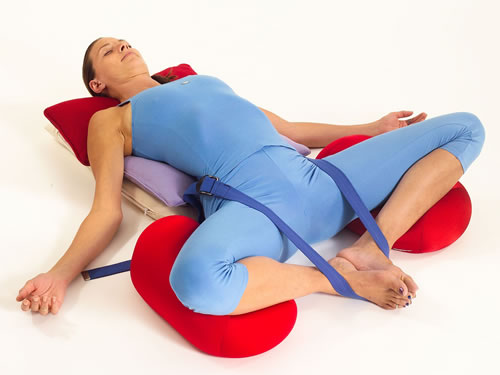
 Supta Baddhakonasana (Reclining fixed angle pose)
Props: A bolster, a blanket, a yoga belt, and two wooden blocks. The bolster supports the back and lifts the chest. The blanket supports the head, alleviating stress and heaviness in the head and neck. The belt helps maintain the angle of the legs easily and holds the feet together. The wooden blocks support the thighs, reducing strain in the groin.
- Sit in Dandasana. Place a bolster behind you, its short end against your buttocks, and place a folded blanket on its far end. Place 2 wooden blocks on their broad sides on either side of your hips. Bend your knees, and join the soles of your feet together. Draw your heels toward your groin. Buckle the belt and loop it over your shoulders.
- Bring the belt down to below your waist. Pass it under both feet to stretch it over your ankles and the insides of the thighs. Move your feet closer to your groin. The belt should feel neither too tight nor too slack, so adjust the buckle accordingly. Make sure that the end of the bolster touches your buttocks. Position a block under each thigh.
- Place your elbows on the floor, and lower your head and back onto the bolster. Make sure that the bolster comfortably supports the length of your back and your head. Your spine should be on the centre of the bolster. Stretch your arms out to the sides, with the palms facing the ceiling. Relax, and extend your groin out to the sides. Feel the expansion of the pelvis, and the release of tension in your ankles and knees. Initially, stay in the pose for 1 minute. With practice, increase the duration to 5-10 minutes.
CAUTIONS
Do not practice this asana if you have lower backache or poor bladder control. If you feel any strain while getting into the pose, use two bolsters instead of one. If you feel strain in the region of the groin, place a folded towel or blanket on both blocks placed below the knees.
 Supta Virasana (Reclining hero pose)
Props: a bolster and a rolled Blanket. The bolster helps people with stiff backs to practice easily. It helps to prevent the knees from lifting off the floor. It also helps to maintain the lift of the chest and the stretch of the torso. The folded blanket under the head prevents eye strain, and ensures that the head and neck do not tilt to one side.
- Kneel in Virasana and place a bolster behind you, the short end touching your buttocks. Place a rolled blanket on the far end. Make sure that the inner sides of your feet touch your hips. Keep your back straight. Place your fingers on the floor beside your toes.
- Press your palms on the floor. Bend both elbows, and lean back toward the bolster. Place your elbows and forearms, one at a time, on the floor. Gradually lower your back onto the bolster. To avoid strain in the pelvic area or the thighs, ensure that your knees remain firmly on the floor.
- Once you lower your back onto the bolster, rest the back of your head on the rolled blanket. Keep your chest fully expanded. Press your shoulder blades down on the bolster to lift your chest. Extend your toes and ankles toward the bolster. Push your feet closer to your hips with your hands. Extend the pelvis, and press your thighs close together.
- Move your arms out to the sides, with the palms facing upward. Extend your neck, but keep your throat relaxed. Drop your eyelids down gently. Experience the relaxation of the thighs and the abdomen, and the lift of the chest. Feel the continuous stretch from the cervical spine to the tailbone. Initially, stay in the pose for 1 minute. With practice, increase the duration to 5-10 minutes.
 Supta Padangusthasana (Reclining leg, foot, and toe stretch)
Props: a mat, a wall, and a yoga belt. The wall steadies the outstretched foot, preventing it from tilting. It also ensures that the body is correctly aligned. The yoga belt, looped around the sole of the raised foot, makes the asana easier for those who are stiff in the hips and pelvic area.
- Place a mat against a wall. Sit in Dandasana facing the wall. Keep a yoga belt beside you. The soles of your feet should touch the wall comfortably, with your toes pointing upward. Press both your palms down on the mat.
- Lower your back on to the mat, supporting your torso on your palms until your head rests on the mat. Bend your right knee, and bring it to your chest. Keep your left sole pressed against the wall. Loop the belt around the sole of your right foot. Hold one end of the belt in each hand. Make sure that you hold the yoga belt as close to your foot as possible. This opens your chest, and keeps your breathing regular and even. Keep your extended leg pressed down on the mat.
- Inhale, and raise your right leg until it is perpendicular to the floor. Hold both ends of the belt with the right hand. Place your left arm beside your left hip. Press the left foot against the wall, and the left thigh on the mat. Stretch your right leg up further, simultaneously pulling your toes toward you with the belt. Feel the stretch in your right calf. Keep your left leg firmly pressed to the floor. Do not bend either knee or allow the left leg to tilt out. Initially, stay in this position for 20-30 seconds. With practice, increase the time to 1 minute. Repeat the pose on the other side.
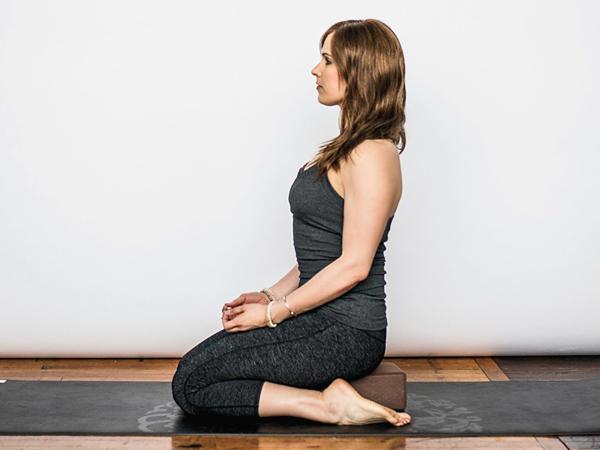
 Virasana (Hero pose)
Props: two bolsters and two blankets. The bolsters support the legs and give the torso an upward extension. The blankets – one folded to sit on, the other rolled and placed between the calves and thighs – relieve pressure on the knees and ankles, and distribute body weight evenly.
- Place 2 bolsters parallel to each other on the floor. Kneel on the bolsters, keeping your knees together. Place the rolled blanket on your shins, and the folded blanket under your buttocks. Sit with your back upright.
- Keep your chest stretched out. Imagine you are squeezing your kidneys and drawing them into the body. Place your palms on your knees. Look straight ahead. Stay in the pose for 30-60 seconds.
 Parsva Virasana (side twist in the hero pose)
Props: a blanket and a wooden block. Sitting on the blanket reduces pressure on the knees and on the ankle joints. The wooden block, positioned on its long side and placed under your hand, makes it easier for you to rotate your torso and to lift and stretch your spine more effectively.
- Kneel on the mat with your knees close together. Gradually separate your feet. Fold the blanket, and place it between your feet. Lower your buttocks onto the blanket, making sure that you do not sit on your feet. Place the block on the floor, behind your buttocks and parallel to them. Place your palms on your knees. Sit with your head, neck, and back erect. Pause for 30-60 seconds.
- Exhale, then place your left hand on the outer side of your right thigh. Rest your right hand on your right hip. The inner sides of your calves should touch the outer sides of your thighs. Push the inner sides of both heels against your hips. Stretch your ankles and then your feet, from the toes to the heels. Feel the energy flow through your feet.
- Open your chest and focus on your kidneys. Imagine you are pulling them into your body. Keep your spine upright by pulling up the inner portion of your buttocks. Press your knees firmly down to the floor and stretch your torso up further. Exhale, then turn your chest and abdomen to the right. Move your right shoulder blade into your body and increase the pressure of your left palm against the right thigh.
- Turn, lifting your ribs, waist away from your hips, and twisting your torso further to the right. Straighten your left arm and pull your left shoulder blade in toward your spine. Place your right palm on the block and press it down firmly. Ensure that your buttocks rest on the folded blanket. Exhale, and twist your torso even further to the right. If you feel discomfort while rotating your torso, place a rolled towel under each ankle and sit on a wooden block. Hold the pose for 20-30 seconds. With practice, increase the duration to 1 minute. Repeat the pose on the other side.
 Upavista Konasana (Seated wide-angle pose)
Props: a wall supports the back and eases breathing.
- Sit against a wall. Then sit in Dandasana with your shoulders and back touching the wall. Keep your back erect. Sit on your buttock bones. Place your palms on the floor, beside your hips, fingers pointing forward. Look straight ahead.
- Press your palms down on the floor to push your torso upward. Exhale, and spread your legs as far apart as possible. Use your hands, one by one, to help you to push your legs even further out to the sides.
- Move your hands behind your buttocks, and place both palms on the floor. Press your heels and thighs down on the floor. Lift your waist and the sides of your torso. Rotate your thighs to the front so that the kneecaps face the ceiling. Shift your weight from the buttocks to the pelvic bone. Stretch each leg from thigh to heel. Hold the pose for 30-40 seconds.
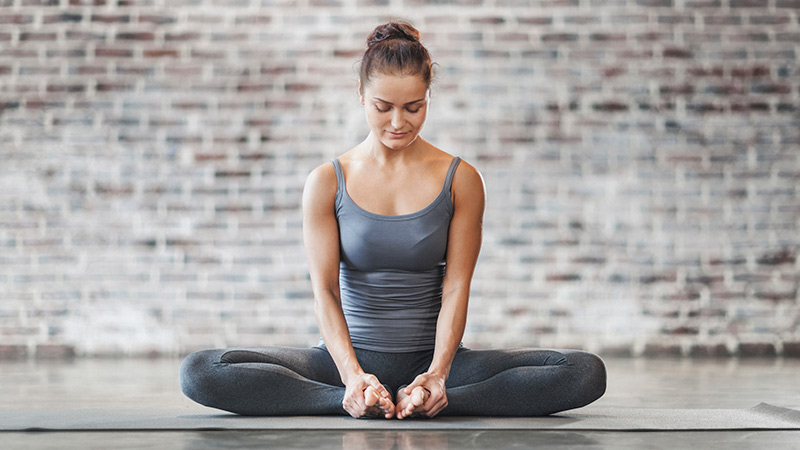
 Baddhakonasana (Fixed angle pose)
- Sit on a bolster placed at right angles to your body. Place a block on either side of your hips. Sit in Dandasana. Bend your knees and join both soles together. Pull your heels closer to the bolster. Beginners may find it easier to use a bolster positioned parallel to the hips.
- Push your knees away from each other and lower them gradually onto the blocks. Take your hands behind your back and press your fingertips to the bolster. Open out your chest and draw in the abdomen. Initially, hold the pose for 1 minute. Gradually increase the duration of the asana to 5 minutes.
 Adhomukha Virasana ( Downward-facing hero pose)
Props: a bolster and two blankets. The bolster supports the head and eases stiffness in the back. A blanket supports the chest, while the second blanket under the thighs relieves painful ankles. If you have migraine, or a stress-related headache, wrap a crepe bandage around your eyes.
- Place a bolster on the floor and put a rolled blanket on it. Kneel with the bolster between your knees. Place the second blanket across your calves and heels. Lower your buttocks onto the blankets. Place both palms on your knees, your feet close together. Imagine you are pulling your kidneys into your body. Pause for 30 seconds.
- Move the bolster toward you. The front end should be in between your knees. Draw the bolster closer to your body so that it is just below your abdomen. Position the rolled blanket on the bolster so that you can rest your face on it. Now, exhale, and move your torso forward. Stretch your arms out fully and place your hands on the floor, on either side of the far end of the bolster.
- Lower your chest to the bolster. Stretch your arms forward, extend the nape of your neck, and rest your forehead and face on the blanket. Push your thighs down, and lower your buttocks toward the floor. Keep your abdomen soft. Open your armpits and extend your sternum. Push your chest forward, broadening your ribs. In order to relax your body, increase the forward stretch of your torso and spine on the bolster. Make sure your buttocks rest on the other blanket. Stay in the pose for 30-60 seconds.
 Paschimottanasana (Intense back stretch)
Props: two bolsters support the head and allow people with stiff backs to hold the pose more easily.
- Sit in Dandasana. Place 2 bolsters, one on top of the other, across your knees. Make sure that your ankles, heels, and big toes are close together. Stretch your arms over the bolsters and bend forward. Hold your feet just below the toes, keeping both legs straight. Press your thighs and knees together.
- Bend from the base of your spine and push your waist forward. Elongate your torso toward your feet, stretching it from the groin to the navel. Make sure that your abdominal muscles do not contract. Rest your elbows and forehead on the bolsters. Keep the muscles of your thighs and calves fully stretched.
- Stretch your neck. Push both your shoulders down and back, moving them away from your ears. Rest your forehead evenly on the bolsters, and do not tilt your head to one side. Your arms should be straight, but not tensed. Consciously relax your neck, face, eyes, and ears. Breathe evenly, and stay in this pose for 5 minutes.
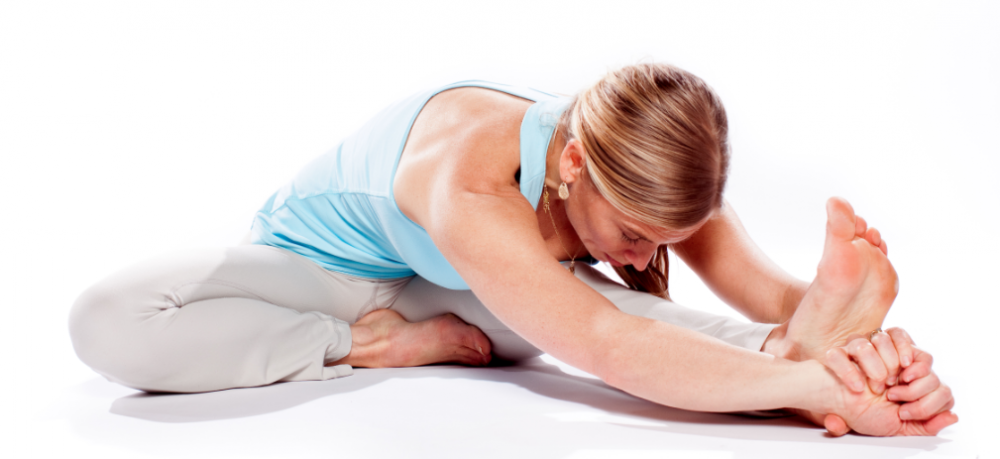
 Janu Sirsasana (Head-on-knee-pose)
Props: a bolster, a blanket and a low open stool. The bolster and blanket supports the head and help those with stiff backs to bend forward easily. The low, open stool facilitates the arm extension from the shoulders to the fingers. It also relaxes and stretches the back of the head and neck, creating a traction-like extension of the spine.
- Place a low stool on the floor. Sit in Dandasana with your feet through it. Sit on your buttock bones. Press your palms to the floor beside your hips and straighten your back. Bend your left leg and bring the heel to your groin. Your toes should touch your right thigh and your legs should be at an obtuse angle. Push the bent knees as far back as you can. Keep your right leg absolutely straight. Place the bolster across your right calf, and place a folded blanket on top of it for added height.
- Exhale, and bend forward from the base of your spine, not from the shoulder blades. Stretch your arms over the bolster and rest your palms on the stool. Keep your left knee pressed to the floor.
- Push your torso forward and hold the far edge of the stool. Stretch from the groin to the navel. Do not allow your abdomen to contract as you bend forward. Rest your forehead on the blanket and close your eyes. Exhale slowly to release the tension in your neck and head. Stay in this position for approximately 1 minute. Repeat the pose on the other side.
CAUTIONS
Do not practice this asana if you have asthma or bronchitis. Avoid the pose if you have diarrhoea as it will aggravate the condition. If your knees are stiff, or if you have osteoarthritis of the knees, practice with a wooden block under the bent knee. If you have a stress-related headache or migraine, practice the asana with a crepe bandage over your eyes.
Disclaimer
The Content is not intended to be a substitute for professional medical advice, diagnosis, or treatment. Always seek the advice of your physician or other qualified health provider with any questions you may have regarding a medical condition.