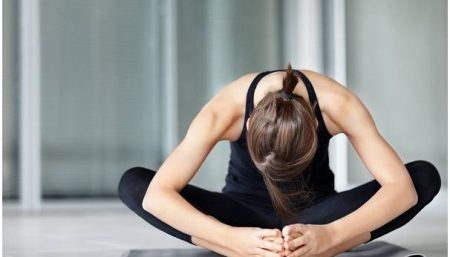
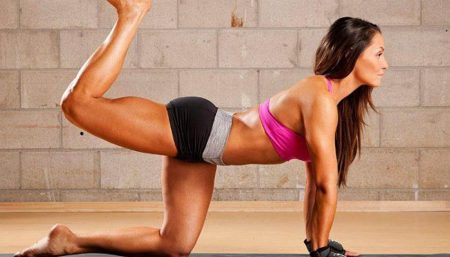
According to Dr. David Musnick and Mark Pierce, A.T.C. (in their book “Conditioning for Outdoor Fitness”), “The goal of stretching is to lengthen a muscle and move the corresponding joints through the full range of motion, thereby allowing both the contractile (muscle and tendon) and the noncontractile (ligament and joint capsule) structures to lengthen.”
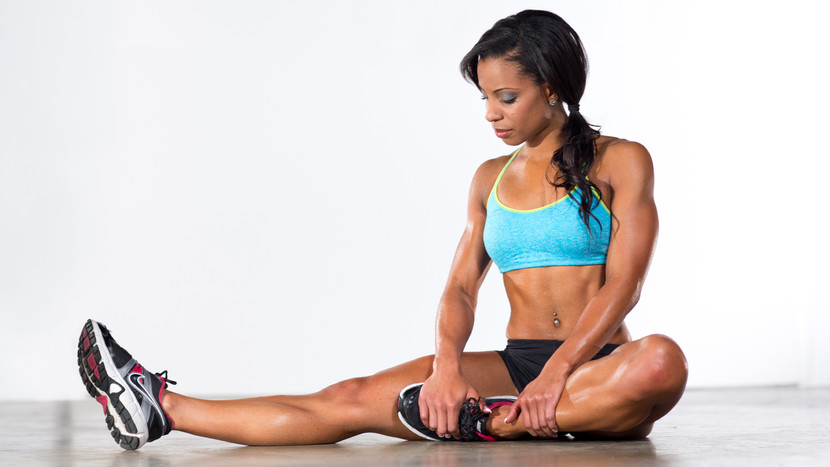
Stretching exercises:
- relieve muscle tension
- keep muscles flexible, which can help your posture and balance
- lengthen muscles and increase range of motion, which helps lengthen your stride
- help prevent muscle and joint injuries by elongating and relaxing muscles
- flush lactic acid out of your muscles.
Do a walk or slow jog for 5-10 minutes, and then stretch.
 Stretch 1
Neck, Scalene and Upper Trapezius
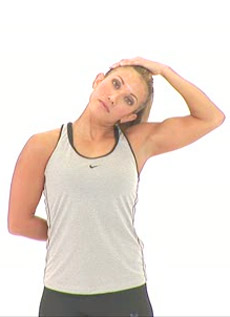 This stretch helps to re-align the cervical spine and is good for posture. It improves breathing and alleviates neck pain. Office workers constantly on computers can do this stretch five or six times a day, and people who carry bags over one shoulder should also do it regularly.
- Place a hand on the side of your head and breathe in. The hand is used only as a guide and does not drive the motion.
- Active the opposing scalene muscles by flexing the neck to the side until you reach your barrier. Once your barrier has been reached, gently pull and hold for two seconds while breathing out, then return to neutral (the starting position). Repeat 10 times.
- There are three scalene muscles that move the neck in slightly different directions. Scalene are used in breathing but also stabilize the neck.
 Stretch 2
Pectoralis Minor (chest)
This stretch will help pull your shoulders back into their rightful spot, reduce rounding of your shoulders and improve your breathing. Your lungs get compressed if your shoulders are rounded; you can’t breathe in properly because your ribcage is also compressed. This stretch will help bring your center of gravity back into alignment.
- Breathe in and place your hands in a position like you’re under arrest.
- Pull your shoulder back and breathe out, extending the elbows and contracting the muscles in the back (rhomboids, middle trapezius). When you reach the end point, lift your shoulders at a 45-degree angle to target the pictoralis minor. Hold for two seconds and release back to neutral. Repeat 10 times.
 Stretch 3
Posterior Deltoid and shoulder capsule
This stretch is more focused on the shoulder capsule, the most mobile part of the body. A lot of people have adhesions – sticky and gluey tissues in the shoulder capsule – which restrict mobility. People who slouch, as well as tennis players, cricket bowlers and baseball pitchers, will benefit greatly from this stretch.
- Sitting down, take a deep breath. Don’t lean forward. Keep your back straight and tighten your stomach.
- Breathe out, raise one arm above your head to maximum range, pointing your fingers upwards, and bring the other arm backwards to the maximum point as a counterbalance. The anterior deltoid is the prime mover here. Hold for two seconds. Repeat 10 times on each side.
- The long head of the triceps also gets a stretch, as do the posterior deltoid and the gleno-humoral (ball and socket) joints. This is a great warm-up for the connective tissue around the joint, which is being supplied with lots of blood and nutrients.
 Stretch 4
Erector Spinae (back extensors)
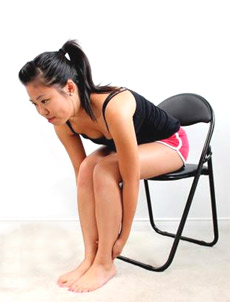 The objective here is to lengthen the spine, which helps to extend your back, giving you more of an upright stance. This is one of the most important postural muscles; it keeps your back straight. Most people are weak and tight in this area, and people who sit at desks all day are particularly vulnerable. This stretch helps correct slouching.
- Sitting up, hold the upper abs (rectus abdominus). Breathe in and lengthen through your spine. Relax your neck and shoulders.
- Contract your abdominals, which releases and relaxes the erector spinae muscle group. Lean forward with a straight back and grab hold of your ankles. Pull through to your barrier, hold for two seconds, then release back to neutral. Repeat 10 times.
- This stretch also works into the sacro-spinalis attachments in the lower lumbar region of the lower back. It lengthens through all three muscles (spinalis, longissimus, illio-costalis) on each side of the erector spinae muscles. This muscle group keeps you erect; if it’s weak, you slump forward and buckle.
 Stretch 5
Upper Quadriceps (thigh)
This should be an integral part of any daily stretching routine because it works what could be the most used muscle in the body. This is what’s called the proximal attachment of the rectus-femorus, the second most important postural muscle, after the hip flexors. This stretch will improve knee extension and improve your gait. It’s also integral to increasing speed, strength and power. It’s essential to have strong but flexible quads, which give you a solid base and are important in stabilizing your knees.
- Sitting in a neutral position, breathe in and lift your heel into your bottom. Keep your back straight and your stomach tight.
- Extend the hips using the hamstring and the gluteals (buttock muscles), which are driving the movement; the hand is merely a guide. When you reach your barrier, use your hand to pull through the barrier to the point of light irritation. Hold for two seconds and release back to start. Repeat 10 times.
- The upper quad is generally the tightest part of the thigh. You should feel the stretch at the Alls (anterior inferior iliac spine) attachment of the rectus femoris.
 Stretch 6
Seated Bent Leg Hamstring
The hamstrings flex the knee and extend the hip. They work synergistically with the gluteus maximus. This stretch will improve your speed and make climbing stairs effortless. Tight hamstrings slow the action of your quads, pulling you backwards like reins on a horse. The vast majority of people who work out have weak hamstrings and gluteals because they over-train their thighs and under-train their hamstrings.
- Sitting down, hold your hamstring just above the knee. Breathe in and contract your stomach.
- The quadriceps extends the knee and drives the motion. The hands are guides; move them below the knee to the calf. Lock your knee, but don’t hyperextend. When you get to the end of the movement, use your hands to push slightly forward to the point of light irritation. Hold two seconds and release. Repeat 10 times.
- The biceps femoris and the semi tendonosis (inner and outer hamstrings) cross the knee joint at the least flexible attachment point. There is a relationship between quad strength and hamstring flexibility. People with weak quads have a harder time extending their hamstrings.
 Stretch 7
Psoas Major and Minor (hip flexor)
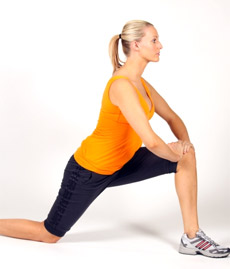 This is one of the most important stretches you can do for lower back flexibility and general mobility. It’s also very beneficial for playing sports because it opens your stride and makes movement more efficient. The hip flexor is considered the body’s number one posture muscle.
- Rest one knee on a cushion. Your back should be straight and your stomach tight, with your pelvis in a neutral position. Place one hand on your hip and the other on your knee. With shoulders and arms relaxed, take a deep breath.
- The driving force of this stretch is the opposing muscle in the gluteus maximus. Tighten your buttocks to extend your hip and push forward from your hips. Keep your hand passive until your reach your barrier, then use it to push through to a point of light irritation. Hold for two seconds and return to neutral. Repeat 10 times. It’s important to not allow the knee to go over the front of the foot to avoid straining the patella ligament (where the quads are attached just below the kneecap.
- The effects of stretching the hip flexor run from the upper thigh into the anterior lower lumbar attachments. Interestingly, not everyone has a Psoas minor. The only way to know is to have an MRI.
 Stretch 8
Spine Rotator
The spine contains your central nervous system, in a small hollow column called the dural tube. This little passageway goes all the way through your spine. Each of the 24 vertebrae need to move independently to create optimal motion. This rotational movement is one of the most important stretches for sports, particularly for golfers, batsmen or throwers. People who have weak backs due to prolonged sitting should do this stretch daily.
- Sitting down, keep your back straight. Cross one leg over the other. Relax your spine, using your palms as balance to help keep it straight. Breathe in deeply. The objective is to achieve elongation and rotation of the spine.
- Breathing out, rotate your spine to your maximum position, putting your arm against your knee for leverage. The back hand is a second lever. Rotate your head and try to look over your shoulder. Hold for two seconds and return to the starting position. Repeat 10 times.
- While one side of the erector spinae (back extensors) is being stretched, the other side is contracting, driving the movement. You can feel this stretch from the bottom of your spine all the way through to the base of your neck. The rotators and the multifidus (the little muscles that rotate and flex each vertebra) also get stretched. This stimulates the synovial fluids that lubricate the joints.
 Stretch 9
Internal obliques (sides of upper body)
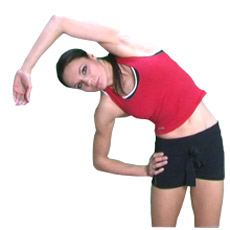 This stretch opens the internal obliques and is useful for sports people like golfers, or for any lateral lunging movement. People who do a lot of sitting in offices often favor one buttock, which tends to lock the hips in an upward position. If you carry a suitcase and lean to one side, it will tilt and compress your obliques. Symmetry is essential. If your pelvis is misaligned, all your vital organs will be as well. If one side is high and the other low, your kidney gets crunched. So this stretch offers relief for your vital organs.
- Standing, breathe in and side-bend as far as you can.
- Breathe out and extend the opposite arm upwards. Look up at your pointed fingers for deeper movement.
- This is a slightly advanced movement for those with sufficient flexibility. Lean across at 45 degrees to finish off the motion. The internal obliques range from the top of the hip to the 12th rib.
 Stretch 10
Outside Lateral Gluteus Maximus (buttock)
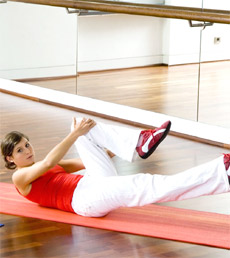 This muscle group is used mainly to enhance speed. When you’re running and your leg is straight, it is powering and pushing off. The most important advantage of this stretch is that it works one of the muscle groups that help strengthen the pelvis. It’s also good for keeping the back in alignment. If the pelvis is out of alignment, spinal mobility will be affected. When you lie on your back, 50% of your weight is taken off your spine.
- Lying on your back raise your knee to 90 degrees and externally rotate your thigh by turning your foot in. Breathe in.
- The muscles driving this action are the quads and hip flexors. Put one hand on your knee and one on your ankle. Move your knee to the opposite shoulder. Breathe out, hold for two seconds, release back to start. Repeat 10 times.
- This stretch will increase the stability of your upper leg and the mobility of your hip extension.
There appear to be more benefits from stretching than disadvantages, but the picture is not as clear as most athletes would like. The research suggests that a stretching program should be individualized according to the athlete’s physical make-up and level of conditioning.
Resource: Stretch Your Life by Tim Noonan & Chris Watts
Disclaimer
The Content is not intended to be a substitute for professional medical advice, diagnosis, or treatment. Always seek the advice of your physician or other qualified health provider with any questions you may have regarding a medical condition.