
As you start on body building and begin to look over the first routine, keep the following principles in mind.
Mastering the Technique: In the beginning, it is essential to master the proper technique for eachexercise. This is the first step; everything else takes a backseat. Don’t worry about the recommended reps for each exercise; its secondary. It doesn’t matter how many reps you do if you’re doing them wrong. When learning a new exercise, do it when you’re fresh. You need to allow a little extra time to study the photos and read the instructions. You need to get a sense of the over all movement as well as the finer points of the exercise.
Adding Intensity: Once you have mastered proper technique, then you can start to push yourself harder. If you haven’t mastered proper technique and you try to push it, you increase your risk of injury.

A Breakdown in Technique: A question that always lingers; “Could I have done one more? Was I really tired?” The simplest criterion is follow a breakdown in technique. This means when you can no longer do the exercise properly, it is time to stop. Let’s say you’re doing a crunch and you have to pull your neck forward to get your shoulder blades off the ground—that’s a breakdown in technique. When you technique gets sloppy, you’re no longer working the targeted area. That means it’s time stop.
Warming Up

It is important to warm up your body before you start exercising. Warming upwill do three important things:
- Increase blood flow to the muscles, allowing them to work more efficiently.
- Increase muscle temperature, allowing the muscles to contract more forcefully and with more speed. In other words, your workouts will be more intense.
- Reduce your chance of injury.
Even if you’re just doing ab work, you should warm your body up and prepare the areas you’re going to work.
Warm up with five minutes of light aerobic work or increased activity. The activity can be functional, such as any household chore where you turn and twist and move your body, or it can be fun, such as playing with or walking you dog.
Next, prepare the areas you’re going to use with the Stretching Routine.
Full Range of Motion: A one, two and a Three

It is essential to perform all exercises through their full range of motion and to keep resistance on the muscles throughout the entire movement. The range of motion will vary from exercise to exercise.
Speed of Movement
As a general rule, you want to keep the speed slow and controlled throughout the entire range of motion. This keeps tension on the ab muscles and doesn’t let gravity and momentum do the work
instead of your abs.
As you get more advanced, you may choose to vary the speed to create variety or to train for sports-specific movements.
Resting
The purpose of rest time is to let your muscles recover for the next set. Many variables determine how long you should rest between ab exercises. In body building routine, your rest time is set for you. But since everyone comes to program at a differentfitness level, you may need to rest between exercises. In general, with ab work, you try to limit your rest between exercises, moving directly from exercise to exercise, here are some exceptions to this rule:
If you’re a beginner, you may need more rest time.
If you’re doing an advanced routine with weight, then you need to rest between exercises.
If you’re doing athletic explosive movements, you’ll also need recovery time.
Breathing

Breathing when you’re exercising or doing any activity is essential in order to stay energized and efficient in your movements.
During exercise, the rule of thumb is to exhale during the working portion of the exercise. By working portion, I mean when you are moving against the most resistance. You should inhale when you’re moving against the least resistance, to refuel by bringing in fresh oxygen.
Let’s put this principle into an exercise situation. If you’re doing a crunch, you are moving against the most resistance when you are raising your torso off the floor, going against the force of gravity. This is when you would exhale. As you lower your body back down, you are moving against less resistance, so would inhale.
If you’re doing a bicep curl, when you’re curling the weight up, you are moving against the most resistance, so you would exhale. When you’re lowering the weight, you are moving against less resistance, so you would inhale.
One caveat when it comes to ab work: Since the movements are small, sometimes it’s hard to stay with this strict breathing form. If you’re struggling, then try to breathe in a rhythm that supports your body’s movement.
Most important, don’t hold your breath!
The Beginning
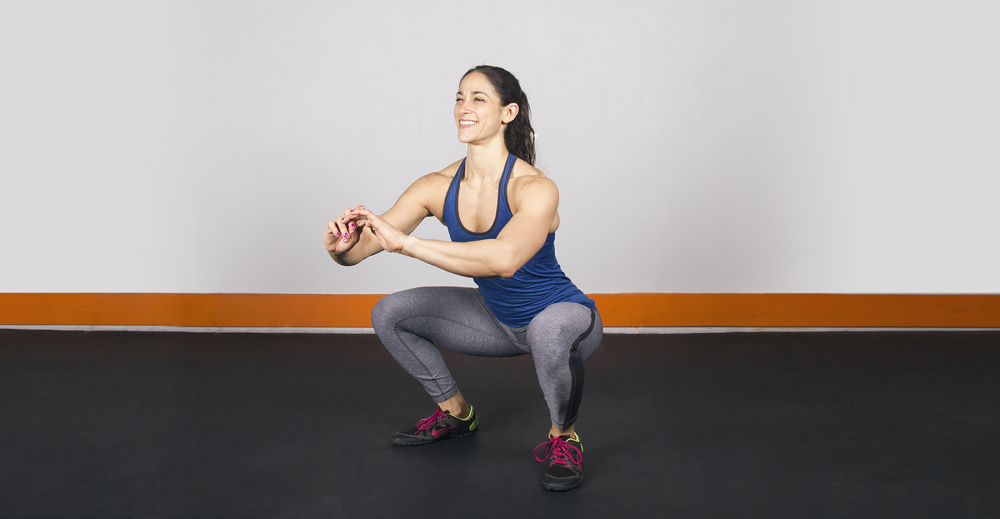
Let’s look in detail at the proper starting position for the center of your body. Setting the center literally means getting the middle of your body ready to work. The first step in this process of finding your “neutral” spine is like finding the balance point in a teeter-totter. When a teeter-totter is balanced, neither end is pointing up or down. It is balanced in the level position. In neutral, your pelvis is also level. Let’s try to make this concrete.
One way to explore neutral is to move through both extremes. Lie flat on your back and tilt your pelvis forward, increasing the curve in your back. Now tilt your pelvis backward, rounding your back against the floor.
Now let your pelvis rest in the middle, balanced between these two extremes. Then let your pelvis naturally relax down toward the floor, so there is a thin space between your lower back and the floor. This is neutral.
The goal of a neutral spine is to set the correct and natural relationship between your pelvis and your lower spine before you start exercising. You want the spine to maintain its natural curve and not be unnaturally flattened or curved.
GOOD PAIN VERSUS BAD PAIN
You’re not going to get to a new and better place without being challenged and pushing your self. When you’re working out, you are going to have to push yourself through some discomfort. As a woman, because of childbirth, you are hardwired to deal with this better than a man. When you’re pushing yourself through the last repetition, causing your muscles to adapt and grow stronger, you need to be able to tell the difference between good pain and bad pain. You want to challenge yourself, not injure yourself.
Good pain is that feeling of being pumped, the good burn of fatiguing the muscle. Eventually, you will naturally push to this point, you will thrive in the burn, learn to love it (in a certain way). It’s that feeling that is expressed in the phrase, “I had a great workout!”Bad pain is a warning sign that says, “Stop! Don’t push!” Warning signs include shooting pains, sharp pains, and spasms. Whenever pain moves beyond the area you’re working, that is a sign to stop and evaluate. Bad pain is an indication that you’ve injured yourself or are putting your self in danger.
Train hard; train smart.

Disclaimer
The Content is not intended to be a substitute for professional medical advice, diagnosis, or treatment. Always seek the advice of your physician or other qualified health provider with any questions you may have regarding a medical condition.