
When the chin is out of proportion with the rest of the face it may detract from the attractiveness of the other features. In the extreme, a jaw that is too large or small affects dental occlusion and requires the attention of orthodontists and oral surgeons.
Even though the dental occlusion is normal, the chin may be out of balance with the rest of the face. It may be recessed or too small, too pointed or crooked, too short or long, or it may protrude too much.
The disproportionate chin may be corrected in two ways (if no dental malocclusion exists):
- Chin augmentation, which reshapes the chin by inserting a silicone implant under the skin, and
- Chin reductions, which involve bone reduction with power bone instruments.
Chin Augmentation
In chin augmentation surgery, implants are used to change the underlying structure, which affects the overall balance of facial features. Often chin implants are used together with other facial implants, particularly cheek implants, however, they can be used alone. This operation is often performed in conjunction with nose surgery as well as a facelift and/or liposuction of the face and neck.
The purpose of chin implant is to create a distinguished, more prominent chin, improve the neckline, enhance the balance of the face and diminish the prominence of the nose.
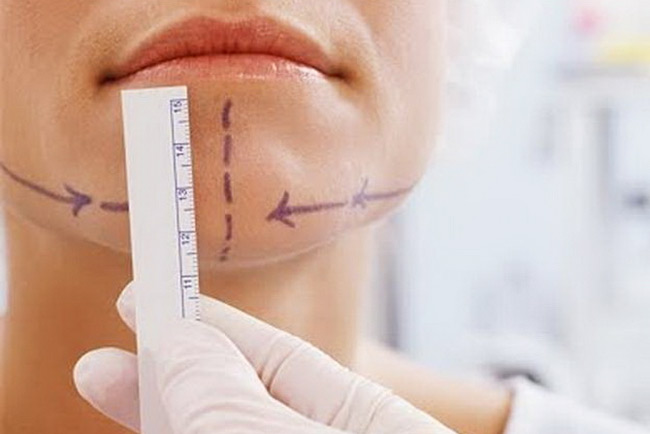
Procedure
Chin implants are usually made of a silastic (silicone) material and are available in two forms: as a gel within a bag, or as a solid block which is either preformed or contoured to each individual need.
Acrylic implants may also be used.
Before your surgery, routine laboratory tests may be requested including blood counts and blood chemistries.
Implant surgery usually takes approximately 30 minutes, and is performed under a local anesthetic, along with intravenous sedation, or general anesthesia depending on your health, the extent of the procedure and whether you are having other procedures at the same time.
After rinsing the mouth with an antiseptic mouthwash, an incision is made in the depression between the lower lip and the external gums of the lower teeth.
A pocket is then created between the lining of the bone and the muscle and fat covering the chin.
The size of the pocket is determined by the structure of the face and the esthetic goals.
An implant to fit the pocket is then put in place, along the lower lip, directly over the jawbone or in the skin just under the chin area and the incision is closed.
The advantage to this procedure is that there is no external scar.
In the past, the incision was made in the natural crease under the chin.
Although the scar was somewhat hidden in the crease, it was still visible.
This is why entering through the mouth is now preferred.
Once the procedure is complete, a light pressure dressing is applied to control swelling and bruising.
Incisions inside the mouth (intra-oral incision) are closed with sutures (stitches) that dissolve. Removable sutures are used for incisions under the chin and are taken out after five to seven days.
o minimize swelling and discomfort, the chin is usually taped for about a week.
The dressing is removed with in 2 days.
In chin reduction surgery, incisions are made either in the mouth or under the chin. The surgeon sculpts the bone to a more pleasing size. For orthognathic surgery, the surgeon will make an incision inside the mouth and reposition the facial bones. The procedure, depending on the extent of the work, takes from less than an hour to approximately three hours.
For comfort, a soft diet is recommended until the dressings are removed.
Hot foods should also be avoided because the area tends to be numb for some time after the surgery and there is a risk of scalding the lower lip.

Am I a good candidate?
As with all elective surgery, good health and realistic expectations are prerequisites, but if you want to change your profile or are having nose surgery, a facelift or facial liposuction, then chin surgery may be appropriate, but:
- Make sure that you are free of known allergies to the implant material.
- Make sure you are not prone to scarring problems such as keloids
- Inform your surgeon about any and all medical conditions and any allergies you may have and whether you are a smoker or have dental or gum problems. Also, tell your surgeon about any medications, herbal supplements or natural supplements you are taking (both prescription and non-prescription).
Preparing for surgery
Your doctor will give you specific instructions to prepare for surgery but here are some general guidelines:
- Avoid aspirin, any aspirin containing medication or any other non-steroidal anti-inflammatories (NSAID),
for two weeks prior to treatment. Because aspirin thins the blood, it can interfere with normal blood clotting and increase the risk of bleeding and bruising.
Smoking inhibits the healing process, so stop smoking before your procedure and if you start again, make sure it is after you are completely healed. - Avoid drinking alcohol a few days before your surgery.
- Make sure to follow any fasting instructions the night before and morning of your surgery. Your doctor may insist on an empty stomach depending on the type of anesthesia.
- Make sure that you arrange for someone to bring you home and to help you out for 24 hours after surgery.

Will there be any pain after surgery?
Only mild discomfort is felt for the first few days after surgery because of the pressure the implant and swelling exert in the area of the chin.
As the swelling subsides, so does the discomfort.
The incision within the mouth is irritating for the first few days, just as with any sore in that area.
A mild painkiller helps to minimize the discomfort until the swelling subsides, usually within 7 to 10 days.
When can normal activities be resumed?
Normal activities can be resumed within 2 days, once the pressure dressing has been removed.
After approximately six weeks, most swelling will be gone, and you can enjoy the results of your procedure. Rigorous activity may be prohibited for the first few weeks after surgery. Normal activity can be resumed after approximately ten days.
Are there any potential complications?
The most common complication is a loss of sensation in the lower lip and chin region.
Due to swelling, pressure is exerted on the nerve supply to the area.
This loss of sensation is usually temporary and will return to normal in several weeks.

- Extrusion or expulsion of the implant, usually as a result of infection or a pocket that is too tight.
- Erosion of the jawbone at the site of the implant occurs if the implant is placed directly on the bone rather than on the lining of the bone.
If the implant is placed too high, erosion of the bone above the implant may cause damage to the dental roots. - A poorly positioned implant will create an unsatisfactory cosmetic result.
Implants may easily be replaced or removed through the original incision in the event of any of these complications or if the results are disappointing.
Can chin implants be combined with other procedures?
A chin implant is often combined with a rhinoplasty.
Liposuction is also commonly done in conjunction with chin implants: fat in sucked from jowls, and under the chin, the cheeks, and the neck.
This contouring provides the finishing touch to the proportional changes that are accomplished withrhinoplasty and chin implants.
Are there alternatives to this procedure?
An alternative to chin augmentation is submental liposuction, in which excess fatty tissue is removed to redefine the chin or neckline. Orthodontistry can treat a malocclusion and misaligned teeth, which are often at the root of a protruding or recessed jaw.
Who inserts chin implants and what do they cost?
Plastic surgeons, otolaryngologists, and oral surgeons trained in cosmetic surgery of the face are specialists who would perform this procedure.
The cost of the procedure varies from $500 to $2,000.
Disclaimer
The Content is not intended to be a substitute for professional medical advice, diagnosis, or treatment. Always seek the advice of your physician or other qualified health provider with any questions you may have regarding a medical condition.