Anger comes in several forms, including outrage, frustration, jealousy, resentment, fury, and hatred. It also masquerades as judgment, criticism, and even boredom. Like all emotions, it is a complex, ever-shifting state involving thoughts, feelings, and bodily changes.
Yogis understand anger as an energy existing, like all emotions, halfway between a physical and mental experience. Like heat or other energies, anger wanes naturally, if we don’t hold it back with psychological defenses—say, denying or repressing it: “Anger tends to arise in a very visceral wave. It arises, crests, and then passes away.”
In yogic theory, asanas, pranayama, and meditation comprise a comprehensive toolkit for freeing up blockages at the mental, physical, or energetic level. Yoga, particularly therapeutic forms like restorative yoga, has proven to be a valuable method of cooling hot-reactives down. Asanas may be in fact the best yogic antidote for anger “because asanas allow you to move the energy.”
The fact that anger manifests differently in each person, and must be treated differently as well. Some of us get so revved up by our catecholamines that we can’t think straight. In those cases, experts have found that methods such as deep breathing, moderate exercise, or walking away from a provocative situation are the best way to lower the arousal level. But for those who are milder by nature, awareness can accelerate anger’s rush through, and out of, the body. Yoga helps people stay with the wave of anger all the way to the other end, The first step at anger management is – do not resist and do not ignore the cause of anger. Experience it fully. Try and develop an attitude of an observer or a witness. Learn to change your role from being the subject to becoming a bystander. See how the anger is operating. See what it is doing to your mind and how. When faced by an anger causing action, immediately get into the mode of exploring and rationalizing with the “whys” and “more whys“.
You will start seeing some wonderful perspectives. You start appreciating that it is not necessarily the desire of the person to hurt you – getting angry is YOUR response. You realize that a person is seeing the situation from his point of view to the best of his intellectual and emotional capability – he may not be quite ‘capable enough’ to appreciate your point of view. This is only natural – because individuals are built in different ways. After all, aren’t you showing similar traits when you are getting angry!
Yoga Asanas to overcome Anger
| All postures should be performed while doing deep, quiet breathing |
The Shoulder Stand (Sarvang Asana)
Benefits
Effective for Excessive anger or hate, Migraine headache, Liver disorder, hemorrhoids, Anemia, Hypertension, Indigestion.
The Shoulder stand invigorates and rejuvenates your whole body.
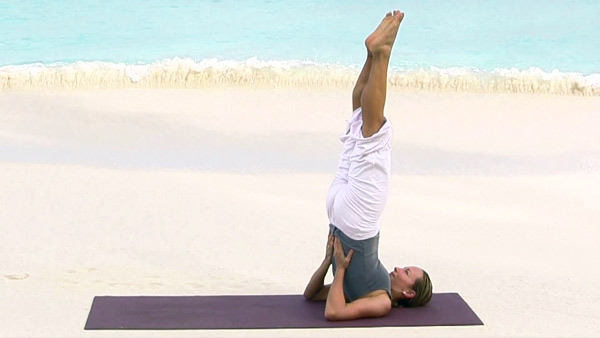
Description of the asana
- Lie down on the floor with your legs together and your hands, push down, by your sides. inhaling, push down on your hands and raise your legs straight up above you.
- Lift your hips off the floor and bring your legs up, over and beyond your head, at an angle of about45°.
- Exhaling, bend your arms and support your body, holding as near the shoulders as possible, thumbs around the front of the body, fingers around the back. Push your back up, lift your legs.
- Now straighten your spine and bring the legs up to a vertical position. Press your chin firmly into the base of your throat. Breathe slowly and deeply in the pose, gradually trying to work your elbows closer together and your hands further down your back toward the shoulders, so as to straighten your torso. Keep your feet relaxed.
Caution
- Shoulder stands should not be attempted without a qualified teacher.
- Any one suffering from breathing difficulties or pain in the upper spine should not attempt these postures.
The Half Bow (Ardha Dhanurasana)
Benefits
Half bow energizes and strengthens the entire body, and especially builds core body strength. Half bow stimulates the kidneys, adrenals and reproductive system.
Description of the asana
- Lie on your belly, with the legs together or a few inches apart. Bring the chin to the floor and slide the right arm along the floor, over your head with the palm facing down.
- Bend the left knee and reach the left hand back to hold onto the left heel or ankle.
- Inhale and kick the left foot into the arm to lift the left leg, head and chest off of the floor. Keep the neck in line with the spine, looking down at the floor. Lift the right arm off of the floor, keeping it parallel to the floor.
- Breathe and hold for 2-6 breaths.
- To release: slowly exhale and lower the leg, arm, head and chest down to the floor.
- Repeat on other side.
Avoid: Recent or chronic injury to the legs, hips, neck or arms; pregnancy, recent abdominal surgery.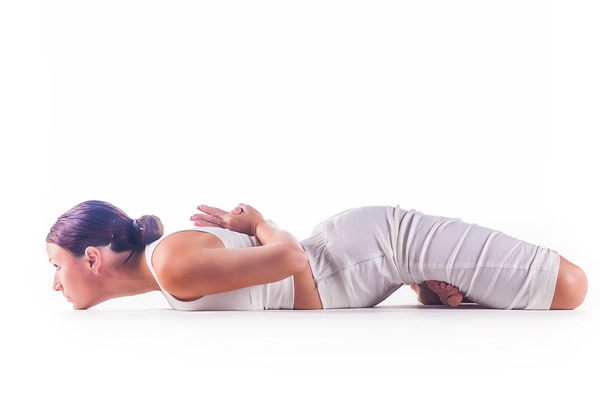
Hidden Lotus Pose (Gupta Padmasana)
Benefits
This asana corrects postural defects of the spine. It may be used as a relaxation or even a meditation pose as it induces peace, stability and emotional balance.
Description of the asana
- Sit in Padmasana. Place the hands on the floor in front of the knees. Leaning on the arms, raise the buttocks and stand on the knees. Slowly lower the front side of the body to the floor in the prone position. Rest either the chin or one cheek on the floor.
- Place the palms together behind the back. The fingers may point downward, or upward in Universal Spirit. If possible, touch the back of the head with the middle fingers. Close the eyes and relax the whole body.
- Return to the starting position, cross the legs the other way and repeat the asana.
- Hold the position for as long as is comfortable. For complete relaxation, the hands may rest on the floor beside the body with the palms upward.Note: The Sanskrit word Gupta means ‘Hidden’. In this asana the feet are hidden under
The Corpse Pose (Shava-asana)
Benefits
The goal of the shava-asana is for the body and mind to be perfectly still and relaxed. Not only should the body be motionless and at ease, but the mind as well should be quiet, like the surface of a still lake. The result will be a deep and stable relaxation that will extend into your meditation or be felt through the activities of your daily circumstances. If find yourself getting drowsy while in the shava-asana increase the rate and depth of your breathing.
Description of the asana
- Lie flat on your back with your legs together but not touching, and your arms close to the body with the palms facing up.
- Keep your eyes gently closed with the facial muscles relaxed and breath deeply and slowly through the nostrils.
- Starting at the top of the head and working your way down to the feet, bring your attention to each part of your body, consciously relaxing it before proceeding on to the next.
- Remain in the shava-asana for between 3 and 5 minutes or longer. If you become sleepy while in the shava-asana begin to breath a bit faster and deeper.
“Antar mouna” meditation
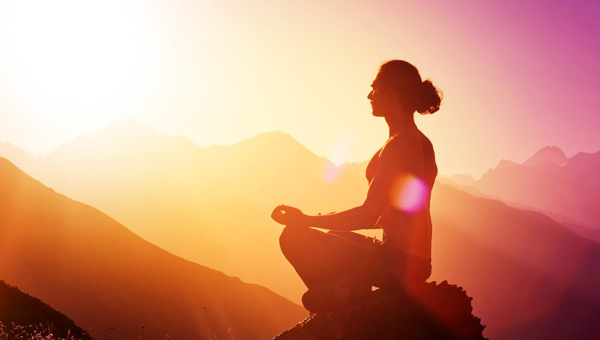
Developing this observer attitude is NOT difficult. Yoga also has some very powerful tools in the form of “antar mouna” meditation techniques that help you cultivate this attitude. Moreover, as you start reaping the wonderful fruits of such an attitude, such a behavioral pattern only gets reinforced.
Over time, with such an attitude, you will see that not only do you get angry less often, but also each brush with an unpleasant situation provides a remarkable opportunity to know your subconscious mind in a better way. Every such insight brings you one step closer to the supreme goal – that is, Enlightenment (perpetual Bliss)
Antar mouna is the technique of inner silence, also known as witnessing. It is divided into six main stages which can be divided into three basic categories. The first two categories are passive, where we sit and observe our mind and our process of evolution, of change in our inner nature, without engagement. We simply observe that tendency to suppress things and to grab onto things and to lose ourselves within our mental process. We do not try to change anything. We simply develop what is called a sense of self. A sense of self is very grounding and calming. We feel a greater sense of safety and trust the more we develop it. So the first stages of antar mouna are simply passive, learning to witness outside sounds or sensations, learning to witness thoughts without getting engaged in suppression of thoughts or involvement in the process. These are the two main states, grabbing onto a thought and pushing it away. Of course, the awareness is the antidote to ignorance.
Once we have that capacity, we go into the next two stages. These are active, to develop mental muscle, like doing mental push-ups. We consciously try to grab onto a thought, to exaggerate the process of grabbing. Then we consciously let it go. One stage is to create a thought, grab it and then throw it away, and the other state is to grab a spontaneous thought as it comes up and then throw it away. So we are developing this internal capacity to deal with our thoughts, feelings, emotions and inner states with greater clarity. In the third category, which is divided into two groups, we throw out any thought that comes into our mind, until we achieve shoonya or emptiness, a luminous emptiness. It is not a dark, tamasic emptiness; it is an emptiness which is full of peace and love.
Antar mouna is one of the most important techniques that we can learn in order to maintain the path, in order to maintain an awareness of duality and polarity, and to be able to hold the negative as well as the positive experiences.
Related Links
Disclaimer
The Content is not intended to be a substitute for professional medical advice, diagnosis, or treatment. Always seek the advice of your physician or other qualified health provider with any questions you may have regarding a medical condition.